
This comprehensive guide provides NDIS providers, plan managers, and sole traders with the fundamental financial framework, accounting strategies, compliance requirements, and software workflows needed to maintain profitable, compliant disability support operations.
Operating a business within the National Disability Insurance Scheme (NDIS) requires balancing participant focused care with rigorous corporate governance. Financial management for NDIS providers involves navigating strict government price caps, complex award wages, phased funding releases, and continuous audit mandates. Mastering NDIS Financial Management requires a specialized accounting structure designed for the disability sector.
Strategic Entity Selection & Legal Foundations
Establishing an NDIS support business begins with choosing the right legal structure. Your business entity dictates tax obligations, personal liability exposure, reporting overhead, and access to capital.
- Sole Trader: Suitable for independent support workers starting out. Operating under an Australian Business Number (ABN), you report business income on your personal tax return. While simple and low cost to establish, it offers no liability protection for personal assets.
- Partnership: Involves two or more individuals sharing profits and liabilities under a single ABN. Partners are jointly liable for all business debts, which can introduce risk in high liability care sectors.
- Company (Pty Ltd): Creates a separate legal entity registered with ASIC, possessing an Australian Company Number (ACN) and ABN. A Pty Ltd structure protects personal assets, offers tax optimization opportunities (such as the corporate tax rate of 25% for base rate entities), and satisfies the standard governance requirements of institutional partners and large funding bodies.
- Trust (Unit or Discretionary): Offers asset protection and tax distribution flexibility. Running a company as a corporate trustee provides both liability isolation and family tax planning options.
Before accepting participant funding, verify that your entity structure supports your long-term expansion plans. Read our NDIS business structure comparison to select the setup for your corporate goals.
Navigating Regulatory Bodies & Financial Compliance
NDIS financial operations are subject to multi agency oversight. Staying compliant requires understanding the primary regulatory bodies:
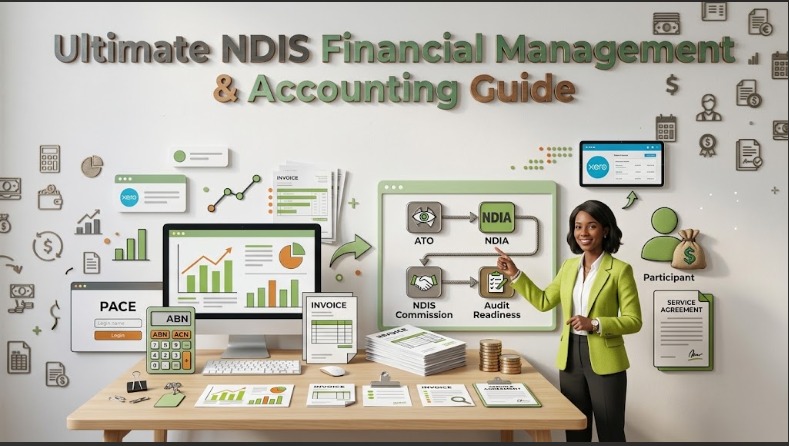
| Entity / Regulatory Body | Primary Responsibilities | Financial & Accounting Impact |
| NDIA (National Disability Insurance Agency) | Manages NDIS operations, pricing arrangements, and funding allocations. | Sets maximum price limits, oversees participant budgets, and enforces claiming rules. |
| ATO (Australian Taxation Office) | Collects tax revenue, enforces GST legislation, and manages income taxes. | Oversees PAYG withholding, BAS lodgements, Super Guarantee compliance, and GST status. |
| NDIS Quality and Safeguards Commission | Regulates provider quality, safety standards, and auditing processes. | Audits financial records, conflict of interest policies, participant funding transparency, and insurance. |
Specialized Industry Accounting Expertise
Navigating the intersections of NDIA pricing rules, ATO tax regulations, and NDIS Commission audits requires specialist oversight. Work with a dedicated NDIS accountant and bookkeeper to build an accounting framework that maintains financial health and audit readiness.
GST Treatment & Taxation Rules for NDIS Providers
Taxation for disability supports differs from general commercial services. Under Section 38-38 of the A New Tax System (Goods and Services Tax) Act 1999, many NDIS supports are GST-free if specific criteria are met:
- The participant has an active NDIS plan.
- The supply is a reasonable and necessary support listed in the participant’s plan.
- The service is delivered under a written Service Agreement between the provider and participant.
- The support is included in the GST free supply determinations issued by the Minister.
Non qualifying services, administrative fees, or non NDIS care incur the standard 10% GST. Incorrectly classifying taxable sales as GST free leads to penalties during Business Activity Statement (BAS) lodgement. Review our guide on GST rules for NDIS services to ensure your invoicing complies with current ATO legislation.
Sole traders must track their income to fulfill personal tax, superannuation, and GST registration requirements once turnover hits the $75,000 threshold. For detailed guidance on deductible expenses and income calculations, check out our NDIS sole trader tax guide.
Claims Processing, PACE Portal & Cash Flow Management
Maintaining working capital requires efficient billing practices and an understanding of the NDIA’s PACE portal system.
Navigating the PACE Portal
The NDIA’s PACE system organizes funding into 21 support categories and uses phased Funding Periods (e.g., monthly or quarterly releases) rather than large annual upfront budgets. Key operational changes include:
- Provider Endorsement: NDIA managed participants must endorse registered providers in the portal before claims can be submitted.
- Funding Periods: Budgets are unlocked in stages, making it critical to monitor participant balance cycles to prevent claim rejections due to unreleased funds.
- Removal of Service Bookings: Formal Service Agreements are essential for protecting revenue, clarifying terms, and preventing payment disputes.
Protecting Working Capital & Cash Flow
Payout delays, roster cancellations, and processing errors can impact cash reserves. To protect working capital:
- Shorten Payment Terms: Invoice within 24–48 hours of service delivery.
- Automate Claiming: Link practice management software directly to the NDIA portal API to reduce manual data entry.
- Build Emergency Cash Reserves: Keep 3 to 6 months of operating expenses in reserve to cover payroll during NDIA processing delays.
For a deeper look at financial management, explore our complete financial accounting guide for NDIS businesses.
Payroll Compliance & SCHADS Award Integration
Payroll represents the largest operational expense for most disability support providers. The majority of support workers are covered by the Social, Community, Home Care and Disability Services Industry Award 2010 (SCHADS Award).
SCHADS Award Complexity
SCHADS payroll compliance requires tracking:
- Minimum Engagement Periods: 2 hour minimum shifts for casual and part-time workers.
- Broken Shift Allowances: Specific pay adjustments for multi part shifts separated by unpaid breaks.
- Overtime & Shift Penalties: Tiered rates for evening, night, weekend, and public holiday hours.
- Kilometre Allowances: Mileage reimbursement when staff transport participants.
Failing to calculate SCHADS pay rates correctly can lead to underpayment claims, Fair Work Ombudsman penalties, and unexpected back pay liabilities. Read our breakdown on SCHADS award payroll compliance to configure your rostering and payroll engines accurately.
Tech Stack: Bookkeeping Software & NDIS Integrations
Managing participant records, timesheets, and line-item claims manually in standard spreadsheets can lead to administrative errors and missed billable hours. Modern NDIS providers build tech stacks around core accounting platforms like Xero or MYOB integrated with specialized NDIS roster software (e.g., ShiftCare, CareMaster, Supportability).
Key features to look for in your software suite:
- Direct PACE Portal Integration: Bulk claim uploads and real time claim status tracking.
- Automated SCHADS Interpretation: Automatic calculation of shift allowances, overtime, and split shift rules.
- Participant Line Item Mapping: Mapping shifts directly to NDIS support catalog numbers for line item accuracy.
Discover the top software combinations for your business by reading our NDIS bookkeeping software guide.
Preparing Financial Records for Quality & Safeguards Audits
Registered providers face regular NDIS Quality and Safeguards Commission audits. Auditors evaluate quality of care alongside financial records, corporate governance, and risk management systems.
Essential Financial Records for Audits
- Service Agreements: Executed contracts matching billed amounts.
- Shift Verification Logs: GPS tracked clock ins, signed timesheets, or case notes matching claimed hours.
- Separation of Participant Funds: Clear segregation between business revenue and participant money (e.g., plan management trust accounts).
- Conflict of Interest Protocols: Documentation showing transparent pricing for multi service providers (e.g., Support Coordination + SIL).
Maintain clean digital records by reviewing our checklist on preparing financial records for NDIS audits.
Driving Sustainability & Profitability
NDIS Financial Management requires balancing financial growth with high quality, participant centered care. By implementing robust entity structures, automating SCHADS payroll, integrating software stacks, and maintaining audit ready financial records, your organization can operate sustainably within the evolving disability care ecosystem.