

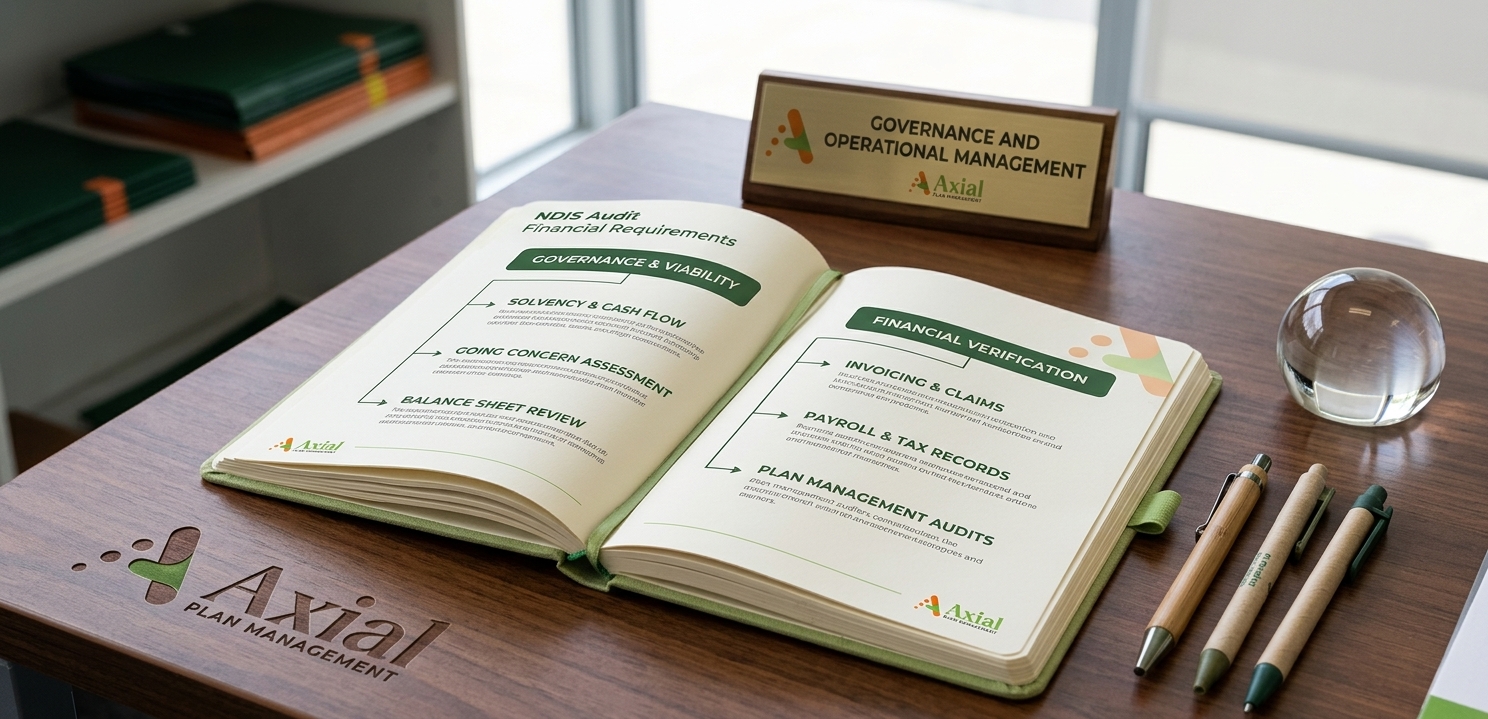
This guide clarifies NDIS audit financial requirements to help providers structure compliant records, navigate auditor reviews smoothly, and avoid registration delays or sanctions.
Understanding NDIS Registration Financial Compliance
Navigating NDIS registration financial compliance is a mandatory step for registered NDIS providers across Australia. Under the framework enforced by the NDIS Quality and Safeguards Commission, service providers must demonstrate sound governance and financial sustainability to maintain their registration status.
Financial oversight ensures that providers possess the resources required to deliver continuous, high-quality support to participants without risking service disruption. Whether you operate as a sole trader, a non-profit organization, or a proprietary limited company, demonstrating robust financial health is central to your audit success. Partnering with a specialist can streamline this process; explore how professional NDIS financial advisor services can help structure your compliance strategy.
Core Components of an NDIS Audit Financial Review
When engaging an approved auditor, providers must submit to a thorough review of their accounting practices, internal policies, and supporting financial documentation. The depth of the financial assessment depends on whether your organization undergoes a verification or certification audit.
1. Solvency and Going Concern Assessment
Auditors evaluate your business’s ability to pay debts as they fall due. A formal going concern assessment verifies that your business holds sufficient cash flow and liquidity to remain operational for at least the next 12 months.
2. Balance Sheet Review and Capital Reserve Verification
A comprehensive balance sheet review confirms assets, liabilities, and equity balances. Auditors examine cash reserves, short-term liabilities, and long-term debt structures to ensure your organization is financially resilient.
3. Separation of Participant Funds
If your organization manages participant funds or acts as a plan manager, accounting records must show strict separation between operating revenue and participant monies. Clear transaction logs, sub-ledgers, and monthly bank reconciliations are non-negotiable.
Preparing for NDIS Mid-Term Audit vs. Full Recertification
Preparing for NDIS mid-term audit presents distinct financial demands compared to an initial registration or full recertification audit. Understanding what auditors examine during each stage ensures your team gathers the correct documentation well in advance.
| Audit Type | Timing | Key Financial Focus Areas | Primary Documentation Required |
| Initial Registration | Start of operations | Financial viability, initial capital, budget forecasts | Business plan, cash flow projections, bank statements |
| Mid-Term Audit | 18 months post-registration | Operational compliance, ongoing solvency, expense tracking | Mid-year P&L, updated balance sheet, payroll records |
| Recertification | Every 3 years | Comprehensive financial audit for NDIS providers | Audited financial statements, tax filings, board reports |
Maintaining up-to-date documentation reduces friction when auditors request proof of compliance. Review practical steps on how to prepare your financial records for NDIS Quality & Safeguards audits to keep your audit trail organized year-round.
Operational Governance and Financial Internal Controls
Strong governance and operational management form the backbone of audit readiness. The Quality and Safeguards Commission looks beyond raw numbers to analyze the internal controls governing your day-to-day financial operations.
- Clear Authorization Frameworks: Documented approval limits for purchases, payroll decisions, and participant service agreements.
- Regular Financial Reporting: Monthly or quarterly profit-and-loss statements, cash flow tracking, and budget variance analyses presented to management or board members.
- Risk Management Protocols: A documented register identifying financial risks (such as funding delays or key client transitions) along with concrete mitigation strategies.
- Separation of Duties: Distinct roles for payroll processing, invoicing, and bank reconciliation to prevent fraud or reporting errors.
Examine how we can help you in NDIS financial reporting to align internal reporting standards directly with Commission guidelines.
Essential Financial Checklist for NDIS Providers
To ensure full readiness before your approved auditor begins their review, compile and verify the following financial records:
- Audited or Verified Financial Statements: Profit & Loss statements, Balance Sheets, and Cash Flow statements for the preceding financial year.
- Bank Reconciliations: Fully reconciled bank statements matching your general ledger accounts up to the current reporting period.
- Tax Compliance Certificates: Proof of current GST filings, PAYG withholding, and Superannuation Guarantee contributions.
- Insurance Documentation: Valid certificates of currency for Public Liability, Professional Indemnity, and Workers’ Compensation.
- Solvency Declaration: A signed declaration from directors or proprietors confirming the entity’s solvency status.
Take the Next Step Toward Audit Readiness
Meeting complex financial standards while delivering exceptional care to NDIS participants requires proactive preparation and expert oversight. If you need tailored guidance or support organizing your accounts for an upcoming audit, contact us today to speak with our compliance specialists.
Conclusion
Navigating NDIS audit financial requirements does not have to disrupt your daily operations. By embedding sound governance, maintaining transparent financial records, conducting regular internal reviews, and completing a thorough financial audit for NDIS providers, your organization can satisfy Quality and Safeguards Commission standards with total confidence. To explore comprehensive plan management solutions and compliance assistance, visit Axial Plan Management.