
Running a successful National Disability Insurance Scheme (NDIS) business requires far more than delivering exceptional care
it demands rigorous financial management, strict regulatory compliance, and bulletproof accounting systems. From tracking shifting price caps to managing complex payroll across casual and permanent rosters, disability service providers face a unique financial landscape.
Whether operating as an independent worker in which case you should follow our dedicated NDIS sole trader tax guide or managing a large team of support workers, partnering with an experienced accountant is vital.
Whether operating as a sole trader or managing a large team of support workers, partnering with an experienced NDIS provider accountant is vital to maintaining operational stability, safeguarding cash flow, and ensuring long-term profitability.
The Complex Regulatory & Financial Landscape of NDIS
Managing finances in the NDIS ecosystem requires balancing multiple regulatory bodies, each enforcing distinct compliance and tax standards:
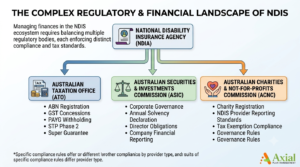
- NDIA (National Disability Insurance Agency): Sets the NDIS Pricing Arrangements and Price Limits, establishes rules for line items, and oversees claims processed through the MyNDIS Portal and PRODA.
- ATO (Australian Taxation Office): Regulates Goods and Services Tax (GST) concessions, Pay As You Go (PAYG) withholding, Single Touch Payroll (STP Phase 2) reporting, and Super Guarantee compliance.
- ASIC (Australian Securities and Investments Commission): Oversees corporate governance, annual solvency declarations, and director obligations for incorporated NDIS providers.
- ACNC (Australian Charities and Not-for-profits Commission): Manages reporting standards, tax exemptions, and governance rules for non-profit and charitable NDIS entities.
5 Pillar Financial Strategy for NDIS Providers
To remain solvent and compliant, NDIS businesses must implement structured financial controls across five key operations:
1. Accurate NDIS Line Item & Claim Reconciliation
NDIS invoicing leaves no room for error. Every claim submitted to plan managers, agency-managed portals, or self-managed participants must align precisely with official NDIS support item numbers.
- Claim Reconciliation: Frequently reconcile claims submitted via PRODA against actual bank deposits. Discrepancies often stem from cancelled shifts, incorrect line items, or exceeding plan caps.
- Invoice Accuracy: Ensure support dates, duration, service agreements, and worker ratios match your shift logs before billing. For additional details on billing rules, explore our guide on ndis-claims-for-providers.
2. Rostering & Payroll Integration (STP Phase 2 & Super)
Payroll is often an NDIS provider’s largest operating expense. Under paying or misclassifying support staff leads to severe ATO penalties and SCHADS Award breaches.
Underpaying or misclassifying support staff leads to severe ATO penalties and breaches of official SCHADS Award payroll compliance rules.
- Software Sync: Connect specialized NDIS care management platforms like ShiftCare or CareMaster directly into accounting software such as Xero or MYOB.
Connecting specialized care management platforms directly into bookkeeping software integrations for NDIS ensures rostered hours flow smoothly into your ledger.
- STP Phase 2: Report real time payroll breakdowns including gross pay, paid leave, and allowances to the ATO with every pay cycle.
- Super Guarantee: Ensure accurate superannuation contributions are calculated on all eligible worker earnings and paid punctually to avoid the Super Guarantee Charge (SGC).
3. Master Cash Flow Forecasting & Operating Margins
Due to payment delays from plan managers or portal processing times, cash flow can fluctuate rapidly.
- Maintain a Cash Buffer: Keep 30 to 60 days of operating expenses in reserve to cover staff wages during claim disputes or delays.
- Calculate True Operating Margins: Track the margin on each service line. Deduct direct worker wages, travel costs, and administrative overheads from the capped hourly billing rate to determine clear service profitability.
4. Structuring for Provider Profitability
Whether operating as a Company, Trust, Sole Trader, or NDIS-registered Non-Profit, structure affects tax obligations and profit distribution. An experienced NDIS provider accountant like Axial Plan Management helps establish optimal structures, optimize tax positions, and protect assets while maintaining compliance.
Whether operating as a Company, Trust, Sole Trader, or Non Profit, structure affects tax obligations. Reviewing our NDIS business structure comparison will help you pick the right entity for growth.”
If you are evaluating service setups or tax requirements across specialized regions, review our tailored insights on tax services in sydney to see how structured planning supports long-term growth.
5. Managing GST Rules on Disability Supports
GST application in the NDIS sector is complex:
- Most direct disability supports delivered under an active NDIS plan to a participant are GST free under Section 38-38 of the A New Tax System (Goods and Services Tax) Act 1999.
- Subcontracted services, administrative fees, or non-NDIS supports may attract 10% GST. Proper ledger setup in Xero prevents accidental GST liabilities.
Most direct disability supports delivered under an active NDIS plan are tax exempt. For details on eligible line items, read our complete GST-free NDIS services breakdown.
Common Accounting Pitfalls to Avoid
| Pitfall | Operational Impact | Preventive Solution |
| SCHADS Award Misclassification | Unpaid overtime or allowance breaches leading to ATO/Fair Work audits. | Automate award interpretation using integrated rostering software. |
| Unreconciled Invoices | Silent cash leakage from rejected or pending PRODA claims. | Conduct weekly claim reconciliation between portal logs and bank records. |
| Mixing Personal & Business Funds | Complications during ASIC/ATO tax assessments and audits. | Maintain dedicated business accounts and clear drawdown logs. |
| Over-reliance on Price Cap Tops | Vulnerability when NDIA reduces price caps in annual updates. | Focus on lean overheads and optimizing labor efficiency rather than max pricing. |
How Axial Plan Management Supports Your NDIS Success
Financial compliance in the NDIS sector demands specialized knowledge. At Axial Plan Management, we bring deep industry experience to assist providers, participants, and businesses with end-to-end accounting, tax strategies, and financial management.
By leveraging cloud accounting software like Xero, establishing reliable cash flow forecasting, and maintaining full compliance across the NDIA, ATO, ASIC, and ACNC, your business can scale securely while delivering crucial care to participants.
Maintaining full compliance across regulatory bodies ensures your operations maintain clean, audit-ready NDIS financial record keeping at every stage.
For targeted assistance in setting up your bookkeeping or managing tax compliance, explore our comprehensive services at ndis-accountant-and-bookkeeper.