Operating as an independent support worker or contractor under the National Disability Insurance Scheme (NDIS) provides flexibility and autonomy. However, managing your business finances as an individual operator means taking full responsibility for tax compliance, income reporting, and deduction tracking.
However, managing your business finances as an individual operator means taking full responsibility for tax compliance, income reporting, and deduction tracking within a comprehensive NDIS accounting setup.
To maximize your take-home earnings while staying fully compliant, partnering with a dedicated NDIS sole trader tax accountant ensures your business structure, tax claims, and quarterly obligations align with Australian standards.
Regulatory Framework & Prerequisites for NDIS Sole Traders
Before delivering services and claiming tax deductions, independent support workers must establish their legal operational framework across key Australian regulatory bodies:
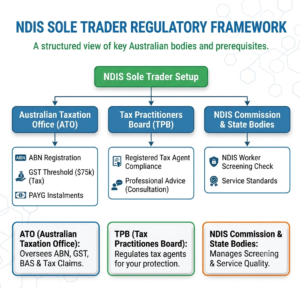
- Australian Taxation Office (ATO): Oversees your ABN registration, income reporting, Business Activity Statements (BAS), and business tax claims.
- Tax Practitioners Board (TPB): Regulates registered tax agents and accountants. Always ensure your tax professional is registered with the TPB to protect your financial interests.
- NDIS Worker Screening Check: Clearance required by state and territory screening units to deliver supports to NDIS participants safely.
Before delivering services and claiming tax deductions, evaluate your operational model. If you plan to hire staff in the future, comparing sole trader vs Pty Ltd structures will help protect your personal assets.
Key Tax Deductions for Independent NDIS Support Workers
Maximizing your legitimate sole trader tax deductions directly lowers your taxable income on your annual personal tax return. The ATO requires that all claimed work related expenses directly connect to earning your income, with written records kept to substantiate claims.
1. Vehicle & Travel Expenses
Traveling between NDIS participants is one of the largest deductible expenses for independent support workers.
If your sole trader business hires casual staff or subcontractors to assist with care shifts, you must adhere strictly to SCHADS Award payroll requirements for minimum hours and shift allowances.
- Cents per km Method: Allows you to claim a set rate per kilometer (up to 5,000 business kilometers per year per vehicle). This rate covers all car operating costs, including fuel, servicing, and insurance.
- Logbook Method: Requires maintaining an ATO compliant 12 consecutive week logbook to establish your business use percentage. You can then claim that exact percentage of all actual vehicle running costs (fuel, repairs, interest, depreciation).
Important Note: Commuting from your home to your first participant’s location is generally classed as private travel by the ATO and cannot be claimed, unless you are carrying heavy specialized disability equipment that cannot be safely left at home.
2. Specialized Equipment & Protective Gear
- Capital purchases such as portable ramps, specialized lifting accessories, or office hardware can often be written off immediately under current instant asset write-off rules rather than depreciated over multiple years.
- Direct consumables such as gloves, sanitizers, aprons, and specialized work uniforms featuring a embroidered business logo are fully deductible.
3. Training, Certifications & Clearances
- Mandatory renewals for your NDIS Worker Screening, First Aid/CPR certifications, manual handling training, and job related professional development courses are tax deductible.
- Initial qualification costs incurred before starting your business are generally considered capital in nature and non deductible.
Navigating BAS, GST, and PAYG Instalments
As your sole trader business grows, your tax obligations evolve based on your turnover and earnings.
Most core disability supports provided directly to NDIS participants are GST free under Section 38-38 of the GST Act. Understanding these specific GST exemption rules for NDIS providers enables you to claim input tax credits on business purchases without misclassifying client invoices.
GST Threshold ($75k Rule)
- Under $75,000: Registration for Goods and Services Tax (GST) is optional.
- $75,000 or Over: You must register for GST within 21 days of reaching or projecting to hit the GST threshold ($75k).
- GST Application: Most core disability supports provided directly to NDIS participants are GST-free under Section 38-38 of the GST Act. However, registering for GST enables you to claim input tax credits on business purchases that include GST.
Business Activity Statements (BAS)
If registered for GST or entered into the PAYG instalment system, you must lodge a quarterly BAS to report your turnover, GST collected/paid, and income tax prepayments.
If registered for GST or entered into the PAYG instalment system, using specialized bookkeeping software for NDIS providers automates quarterly BAS lodgements and keeps track of claims.
Pay As You Go (PAYG) Instalments
Unlike standard employees whose employer deducts tax from every pay check, sole traders receive gross payments. The ATO enters sole traders into PAYG instalments once income tax liability exceeds threshold limits. This system spreads your expected tax liability across quarterly prepayments, preventing a single lump-sum tax bill at the end of the financial year.
Summary Checklist for Sole Trader Tax Compliance
| Obligation | Threshold / Requirement | Frequency |
| ABN Active | Mandatory before invoicing clients | Ongoing |
| GST Registration | Required once turnover hits $75,000 | Within 21 days of reaching threshold |
| Logbook Renewal | 12-week log required every 5 years (or when usage changes) | 12 consecutive weeks |
| BAS Lodgements | Required if GST registered or on PAYG instalments | Quarterly |
| Personal Tax Return | Reports business income (Schedule 2) alongside personal earnings | Annually (by 31 October or Tax Agent extension) |
Keeping accurate receipts, shift logs, and mileage books ensures you meet both ATO guidelines and official NDIS audit record-keeping requirements during verification checks.
How Axial Plan Management Helps NDIS Sole Traders Succeed
Managing your own day-to-day client care while staying top of tax law changes can quickly become overwhelming. At Axial Plan Management, our professional team offers tailored support to keep your independent operations structured and financially sound.
If you require tailored tax guidance, business setup advice, or support with your individual tax lodgements, explore our local services at tax-services-in-fairfield.
For broader provider support and structured bookkeeping advice tailored to sole operators, check out our dedicated insights on how-we-can-help-you-as-an-ndis-tax-accountant to see how Axial Plan Management can help streamline your business compliance.