
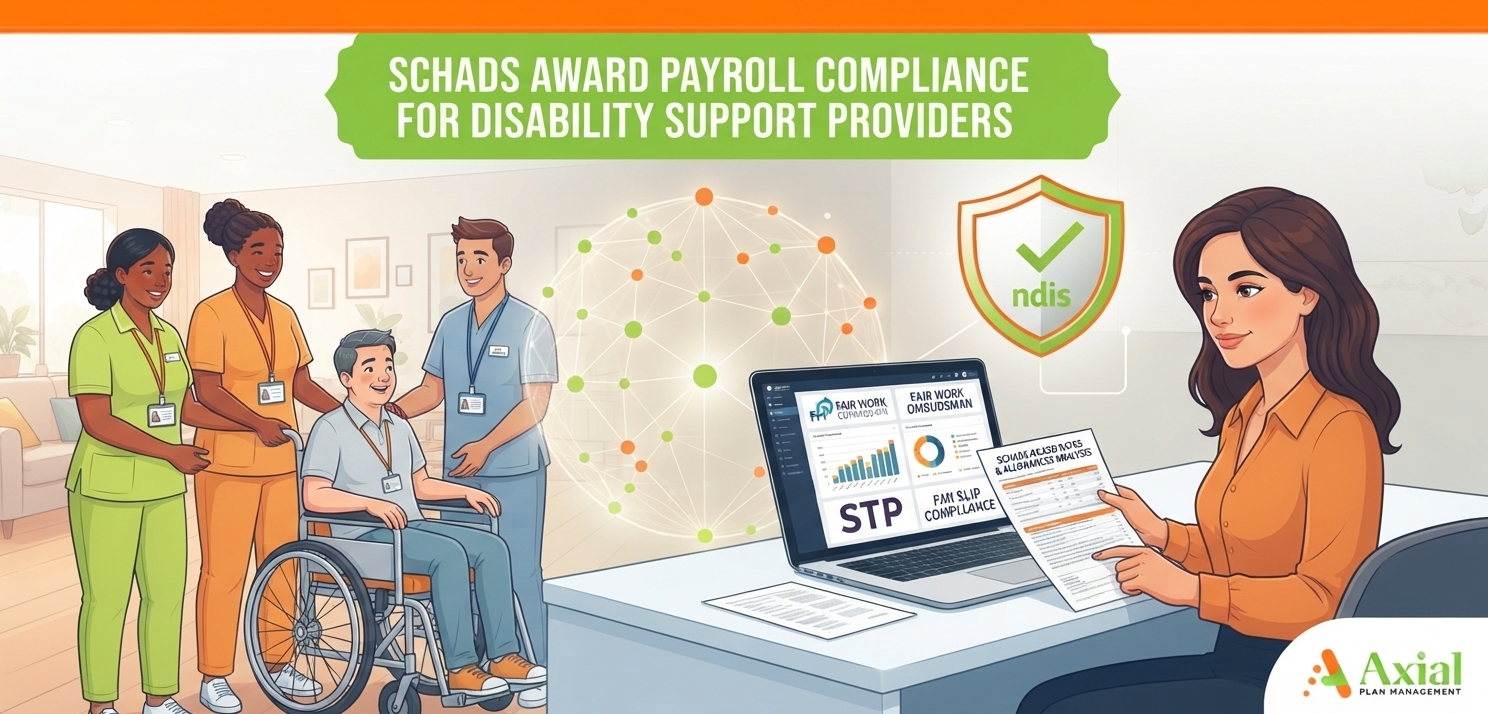
Navigating the complexities of the Social, Community, Home Care and Disability Services (SCHADS) Industry Award is one of the most significant challenges for NDIS providers in Australia.
The disability support sector is built on a foundation of care, but that care is underpinned by a labyrinth of industrial relations, legal obligations, and complex financial requirements. Getting payroll wrong does not just cause administrative headachesit can lead to serious legal repercussions, expensive underpayment claims, and damaged reputations.
Whether you are a sole trader just entering the market or running a large, multi-site support organization, achieving absolute precision in payroll requires a deep, ongoing understanding of ever-changing regulations.
At Axial Plan Management, we understand that your primary focus should be on providing exceptional care, not getting bogged down in the intricacies of industrial relations, tax law, and Fair Work regulations. By partnering with a dedicated NDIS specialist accountant, you can ensure your business remains compliant, efficient, and financially healthy while you focus entirely on improving participant outcomes.
Why SCHADS Compliance is Non Negotiable
The Disability Services Industry is heavily regulated by the Fair Work Commission. The SCHADS Award sets the legal baseline for pay, hours of work, and working conditions for employees in the disability sector. Because the nature of disability support often involves highly irregular hours, overnight sleepovers, and unique, high-intensity shift patterns, the award is inherently complex.
If your internal systems are not configured correctly to calculate these complex pay conditions, you are at a high risk of inadvertent underpayment. Implementing a comprehensive NDIS financial accounting strategy helps mitigate these systemic risks early.
The Fair Work Ombudsman (FWO) has intensified its focus on the health and community services sectors. With the widespread implementation of Single Touch Payroll (STP) reporting, the ATO and the FWO now have increased visibility into employer payroll practices. If your internal systems are not configured correctly to calculate these complex pay conditions, you are at a high risk of inadvertent underpayment. Even minor errors, when replicated across a large workforce, can turn into significant liabilities that threaten your provider business.
Key Regulatory Requirements to Monitor
SCHADS Award Rates and Penalty Rates
Unlike many standard industries, the disability sector is defined by its 24/7 nature. SCHADS Award rates are not static; they fluctuate based on the time of day, the day of the week, and whether the work is performed on a public holiday. Calculating overtime penalty rates correctly is essential. Missing a penalty calculation for a single weekend shift can accumulate into significant liability over a financial year, potentially impacting your cash flow and regulatory standing.
Managing Shift Allowances and Complex Arrangements
Many providers struggle with the specific definitions under the award, particularly regarding the nuances of support work:
- Sleepover Allowance: When a support worker is required to stay overnight at a client’s premises, there are specific payment structures that must be adhered to.
- Broken Shifts: Understanding when a shift is legally considered “broken” and the specific allowances that apply is a common point of confusion.
- Minimum Engagement Hours: You must ensure that your employees are paid for their minimum guaranteed hours, even if client schedules change abruptly.
Accurately tracking these irregular shift allowances is equally critical when managing your NDIS sole trader tax and BAS obligations at quarter end.
Client Cancellation Rules
The NDIS environment is dynamic. If a participant cancels a session, providers must navigate the intersection of NDIS Price Guide rules and the SCHADS Award. You must ensure that your roster management software accurately reflects the distinction between billable hours and the hours for which you are legally obligated to pay your staff under the award, even in the event of a last-minute cancellation.
If a participant cancels a session, providers must navigate the intersection of NDIS Price Guide rules and official GST free NDIS pricing guidelines to prevent claim rejections.
Integrating Systems for Compliance
Manual payroll processing is a relic of the past and a recipe for error. To maintain compliance, providers must leverage robust technology.
Roster Management and Payroll Integration
Your roster management software must be fully integrated with your payroll system. When a worker clocks in for a shift, the software should automatically apply the correct SCHADS classifications, including all relevant penalties and allowances. This integration minimizes manual data entry, which is the primary source of payroll errors in the sector.
To minimize manual data entry, connect your rostering system directly with NDIS tailored bookkeeping software designed specifically for care providers.
STP and TPAR Obligations
Single Touch Payroll (STP) requires you to report employee pay, tax, and superannuation to the ATO each time you pay your staff. Furthermore, NDIS providers must be diligent with their Taxable Payments Annual Report (TPAR). An NDIS specialist accountant can help you ensure that your payroll software is perfectly configured to handle these reporting obligations seamlessly, preventing errors that could trigger an audit.
Ensuring your payroll software is perfectly configured allows you to maintain clean, audit ready NDIS financial records whenever compliance auditors review your books.
Pay Slip Compliance
The FWO requires strict adherence to pay slip formatting. Every pay slip must accurately reflect the base rate, any applicable penalty rates, allowances, and superannuation contributions. If your pay slips are ambiguous, it is difficult to prove compliance in the event of an FWO inquiry.
The Role of an NDIS Specialist Accountant
When you operate in the disability sector, generalist accounting advice is often insufficient. You need an NDIS specialist accountant who understands the specific financial jargon of the sector, from NDIA funding cycles to the nuances of SCHADS Award interpretations.
As your payroll expands, ensure your operations are built on an appropriate NDIS business entity structure to protect assets and manage tax efficiently.
An NDIS specialist accountant helps you:
- Configure Payroll Software: Systematically setting up systems to handle complex penalty rates and allowances automatically.
- Audit Processes: Conducting regular, proactive payroll audits to identify potential underpayment risks before they become legal issues.
- Stay Updated: Ensuring your payroll practices evolve alongside Fair Work Commission updates.
- Taxation and Reporting: Managing your STP and TPAR requirements to maintain a clean record with the ATO.
Streamline Your Payroll Compliance Today
Are you worried about the complexity of your current payroll processes? Do you feel like you are always one audit away from a major headache? Don’t leave your compliance to chance. Get a comprehensive, professional review of your payroll systems and ensure your business is fully aligned with the latest Fair Work requirements. Contact Axial Plan Management today to speak with an expert team dedicated to your financial health.
Conclusion
Managing SCHADS Award compliance is a critical component of running a sustainable, ethical, and successful disability support business. From understanding the nuances of shift allowances and complex overtime penalty rates to ensuring your STP and TPAR reporting is accurate, the responsibilities are vast. By leveraging technology and working with a dedicated NDIS specialist accountant, you can protect your staff, your participants, and the long-term viability of your business.
Remember, compliance is not just about avoiding penalties; it is about fostering a professional workplace where your staff feel properly valued and supported. Visit Axial Plan Management to discover how we can help you navigate these regulatory challenges with confidence