
This 2026 provider guide clarifies essential NDIS invoice requirements to help disability service providers craft fully compliant billing documents, prevent payment rejections, and secure prompt, reliable financial reimbursements.
Delivering exceptional disability support services is at the heart of what you do as an Australian provider under the National Disability Insurance Scheme (NDIS). However, maintaining a sustainable practice requires efficient back-office administration. Under the National Disability Insurance Agency (NDIA) PACE portal system, automated compliance checks are enforced strictly across all submitted claims.
Understanding and consistently applying ndis invoice requirements is the single most effective step you can take to prevent payment delays, clear compliance audits, and maintain steady cash flow for your business.
Supporting Participants: How to Apply for NDIS and Set Up Compliant Billing
Before issuing any invoices, service providers and participants must establish clear operational foundations. Knowing how to apply for NDIS funding and structure a formal Service Agreement ensures that all billed supports align directly with approved participant plan categories. A well constructed Service Agreement outlines agreed hourly rates, cancellation terms, travel allowances, and claim types establishing mutual transparency before support delivery begins.
When you generate billing documents, meeting standard ndis invoicing requirements guarantees that plan managers or the NDIA can verify your services against the participant’s active plan allocation without administrative friction.
The Essential Checklist: Mandatory NDIS Invoice Requirements
An NDIS invoice is more than a standard payment request it is a legal compliance document used to account for public funding. Missing even a single mandatory field can trigger automatic processing flags or claim rejections. Every document you issue should include the following core details:
1. Provider Information
- Business Name: Must match your registered business entity as recorded on the Australian Business Register (ABR) and NDIS portal.
- Australian Business Number (ABN): Displayed prominently on the header.
- Contact Information: Physical or postal address, professional email address, and phone number.
2. Participant Information
- Full Legal Name: The participant’s official legal name (not nicknames or parent/guardian names).
- NDIS Reference Number: The unique 9 digit identification number assigned by the NDIA.
- Service Location: Required for Specialist Disability Accommodation (SDA) or home based core supports.
3. Invoice Metadata
- Unique Invoice Number: Sequential, non duplicate numbering for clear audit trailing.
- Invoice Creation Date: The date the document was generated (which must occur after service delivery).
- Payment Details: BSB, Account Number, Account Name, and payment due date.
Detailed Line-Item Breakdown and NDIS Support Codes
Generic descriptions such as “Support Services – $400” are a leading cause of claim rejections. The NDIA requires complete itemised transparency. For every service delivered, your document must fulfill strict invoice requirements ndis standards by listing:
- Date of Service: The actual calendar date the support took place (distinct from the invoice creation date).
- NDIS Support Item Code: The exact line-item code from the official NDIS Support Catalogue (e.g., 01_011_0107_1_1).
- Service Description: A concise explanation of the service provided.
- Quantity & Unit Rate: Total hours, days, or kilometres multiplied by the unit rate. Rates must not exceed maximum NDIS price limits.
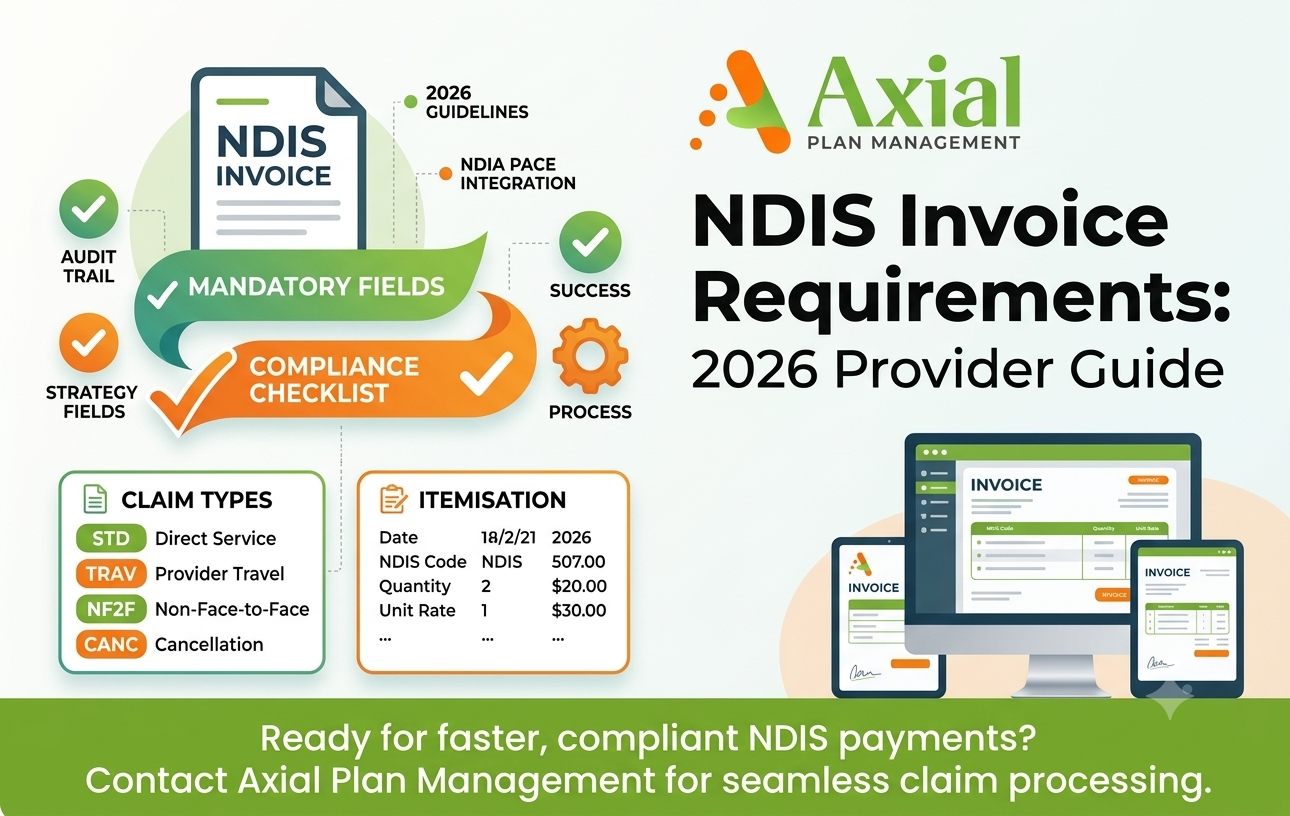
- Claim Type Flags: Explicit codes indicating delivery conditions, such as standard face to face (STD), provider travel (TRAV), non face to face support (NF2F), or short notice cancellation (CANC).
| Support Claim Type | Code | Typical Application Scenario |
| Standard Delivery | STD | Direct face to face or virtual support sessions |
| Provider Travel | TRAV | Travel time or mileage incurred by workers to deliver care |
| Non-Face-To-Face | NF2F | Documentation, progress reporting, or care coordination |
| Short Notice Cancellation | CANC | Cancellations made within agreement notice windows |
Rejections often happen when an invoice line item conflicts with a participant’s funding limits or support category boundaries. Staying up to date on current NDIS budget rules and funding structures helps providers align their billing directly with NDIS pricing standards. Submitting clear, compliant invoices directly to a participant’s NDIS plan manager speeds up processing times and ensures rapid reimbursement.
Goods and Services Tax (GST) Standards
Most supports funded under the NDIS are GST free under Australian tax law provided three conditions are met: the recipient is an NDIS participant, the support is reasonable and necessary, and a written Service Agreement is in place.
Invoices should explicitly display “GST free” for qualifying line items. If non-qualifying administrative fees or non-disability consumables are billed, GST (10%) must be shown separately as a distinct tax item.
Troubleshooting Invoicing Pitfalls and Payment Delays
Even experienced providers occasionally encounter payment hiccups. Understanding common error patterns helps you audit-proof your financial administration.
If you experience unexpected rejections, reviewing why NDIS invoices get rejected and how to avoid it will highlight critical fixes like correcting mismatched support codes, preventing price cap overcharges, and avoiding duplicate invoice numbers.
Likewise, when payments are stalled, understanding NDIS invoice not paid? Here’s what is usually going on helps identify whether the issue stems from exhausted participant funding, unlinked provider records in the portal, or missing service agreement approvals.
Streamlining Claims Across Plan Management Types
Your submission workflow varies depending on how participant funds are managed:
- Plan Managed: Send PDF invoices directly to the participant’s chosen Plan Manager. Plan managers verify compliance with ndis invoice requirements before requesting funds from the NDIA and paying you directly.
- Self Managed: Invoices are sent directly to participants or their nominees, who process claims via their portal and reimburse you.
- Agency Managed: Registered providers claim directly through the my NDIS portal under current PACE guidelines.
Partner with Experts for Faster Payments
Maintaining accurate administrative workflows does not have to slow down your support delivery.
If you want to ensure stress free financial administration, prompt claim turnarounds, and expert billing guidance, contact us at Axial Plan Management today to learn how our dedicated team can support your practice.
Conclusion
Mastering ndis invoice requirements is essential for every Australian disability service provider navigating the 2026 regulatory landscape. By ensuring precise line item descriptions, valid support item codes, compliant GST designations, and accurate participant details, you protect your business against administrative friction and unnecessary payment delays. Partnering with experienced professionals like Axial Plan Management gives you complete confidence that your invoices are processed accurately and paid on time, leaving you free to focus on empowering NDIS participants.
.